In my last post I talked about schemas — the hidden patterns from childhood that quietly run our adult lives. But here’s something that surprises people: schemas themselves aren’t really what ruin your life. They trigger you, they stir up old memories and emotions — but what actually causes the damage is how you cope with them.
And we all cope in one of three ways. One of them, interestingly, looks exactly like having your life completely together.
The three coping styles
Surrender. This is when we simply believe the schema. We start thinking we’re a failure, that nobody will ever choose us, that we’ll never be as happy as everyone else. It can also look quieter — going passive, accommodating everyone around us. We might even say it out loud: “you’re always so much smarter than me,” “you have such high standards, I don’t.” We compare ourselves and act as if the schema were plain fact.
Avoidance. Here we dodge anything that might trigger the schema. We don’t take the job we could actually succeed at, out of fear of failure. We do things below our potential. We go numb — avoiding the things that could excite us, because those same things could also scare us. The result is a very flat life: not much fear, but not much excitement either.
Overcompensation. This one is fascinating, because from the outside it often looks like strength. People who overcompensate can seem like leaders — we want to follow them, we feel safe with them, they look like the healthiest adults in the room. But the very same schema — failure, defectiveness, a fear of being hurt — can be exactly what’s driving that strength. It can show up as needing to control everything, never allowing a mistake, always being prepared — or as lashing out, setting boundaries in an exaggerated way, showing everyone who’s the strongest in the room. It looks like a superhero. Underneath, there’s often a schema.
Meet your parts
Have you ever noticed yourself acting completely out of character? Normally you’re calm and composed, and then suddenly you lash out, or shut down. What can explain that is the concept of parts — the different internal states we all move between.
The vulnerable child
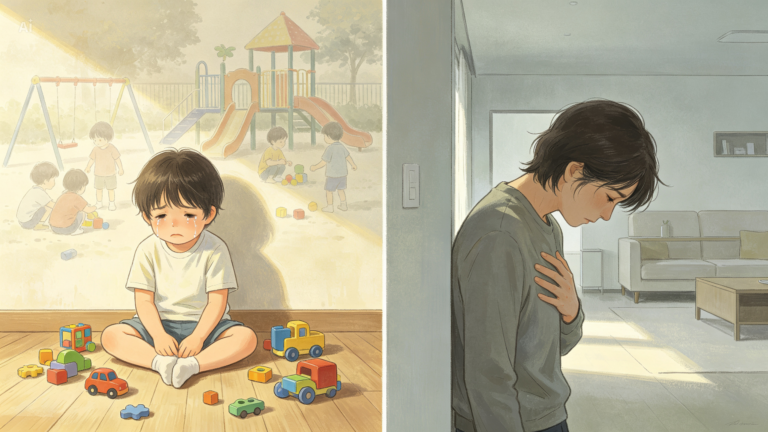
This is the most tender part of you — the one you don’t want to show anyone, because it’s the part that can be hurt the most. It’s those moments of feeling sad, anxious, helpless, or missing someone deeply. It’s very physical: chest pain, racing thoughts, the feeling that nothing will ever be okay, that whatever’s happening is a catastrophe. When you’re in that helpless state, it’s a sign your vulnerable child has taken over. In a way, we’re carrying the same brain we had at five or ten years old — the neural pathways are still intact, which is why we can suddenly feel like those helpless children again.
The inner critic
Everybody knows this part. It’s the one that says: “You could do better, faster. Emotions are bad. Never show sadness. What you said was stupid.” Or, more harshly: “Nobody likes you. Nobody wants you here. They all know how stupid you are, and nothing will ever get better.” These are deeply depressing, disarming thoughts — and the same rule applies as with schemas: whatever the critic says, we tend to believe it completely. Sometimes we’re aware of it; sometimes it just shows up as pain in the body.
The parts that protect us
Now here’s the connection: remember those three coping styles — surrender, avoidance, overcompensation? They show up inside us too, as parts that protect the vulnerable child from the inner critic.
The overcompensating part might keep you up all night making something perfect, so the critic can’t say “you’re not good enough.” The avoiding part keeps you away from anything risky. And the surrendering part often looks like the people-pleaser — always putting everyone else first. It can be as small as this: someone offers the last piece of cake. You want it, you notice they want it too, and you just… can’t take it. You never put yourself first. On some level that’s beautiful — and we’re lucky to have people like that. But that’s the thing about schemas and parts: it’s the rigidity that’s the problem. If it’s every single time, if you never put yourself first, it’s not kindness anymore — it’s coping, coping so you don’t feel bad. Almost everything in psychotherapy comes back to this: a lack of balance, a lack of flexibility.
The good parts
It’s not all wounds and protectors. We also have the happy child — my favourite. It’s the playful, joking part; for some people it’s a book and a hot bath, for others it’s dancing all night with friends. It’s the moment we feel careless and relaxed and aren’t trying to be anything at all.
And the healthy adult — ideally the part running your life day to day. It pays the taxes, remembers friends’ birthdays, sets boundaries, is empathetic to the people we love, and takes care of us: enough sleep, seeing the people who matter. The most content moments in life tend to be when the healthy adult and the happy child are the two parts most on the surface.
Why the vulnerable child matters most
Every therapist most wants to reach the vulnerable child — because that’s the part that heals when it’s finally shown and met with acceptance. If we never let it out, it starts to feel like we’re not really seen for who we are. Rejecting that part completely is, in a way, rejecting ourselves. And accepting the part we’re most ashamed to show creates the most balance — and the most self-love — a person can have.
The one thing to remember
Here’s the headline: all of these are parts. They are not the whole you.
So when the inner critic attacks you over something small — your child is crying in the middle of a store and you suddenly feel like a terrible parent — you can pause and remember: this is just a part. This is the inner critic. It’s not the whole of me. And you can pacify it. That’s a lot of what we do in therapy — calming the coping parts and the critic, and making more room for the happy child, the vulnerable child, and the healthy adult.
This is exactly how we create distance between our past and who we want to be now. When you notice a part, name it, and feel it in your body — you can stop it from taking over your life. And that is powerful, because it gives you back the control to be who you really are.
If you’d like to go deeper into this work, you can find out more about workshops and working with me on my website, or follow along on Instagram.
This article is for educational purposes and is not a substitute for individual therapy or professional mental health advice.